





By Aisha Ahmed
Jigawa state lies in an ecological belt where wet and dry seasons alternate dramatically. The heavy rains can swell rivers, overflow seasonal creeks and flood vast farmlands.
These flood have, in recent years, grown in frequency and intensity due to climate variation.
When the rains intensify, the consequences are immediate and harsh, resulting to loss of crops, broken infrastructure, displacement of families and outbreaks of waterborne diseases, with women and children having the worst experiences due to their vulnerability.
Jigawa communities like Auyo, Kirikasamma and Malam-Madori Local Government Areas, have borne the brunt of these floods.
In 2024, severe flooding displaced thousands of households, wiped out farmlands and plunged many families into hardship, where the scale of that crisis prompted one of the most significant disaster responses the Nigeria Red Cross Society (NRCS), has undertaken in northern Nigeria.
Since then, the Society decided to search for a permanent solution to curtail the disaster through a multi-stakeholder approach and with the warning of early rainfall for 2026 season, the NRCS stormed Jigawa.
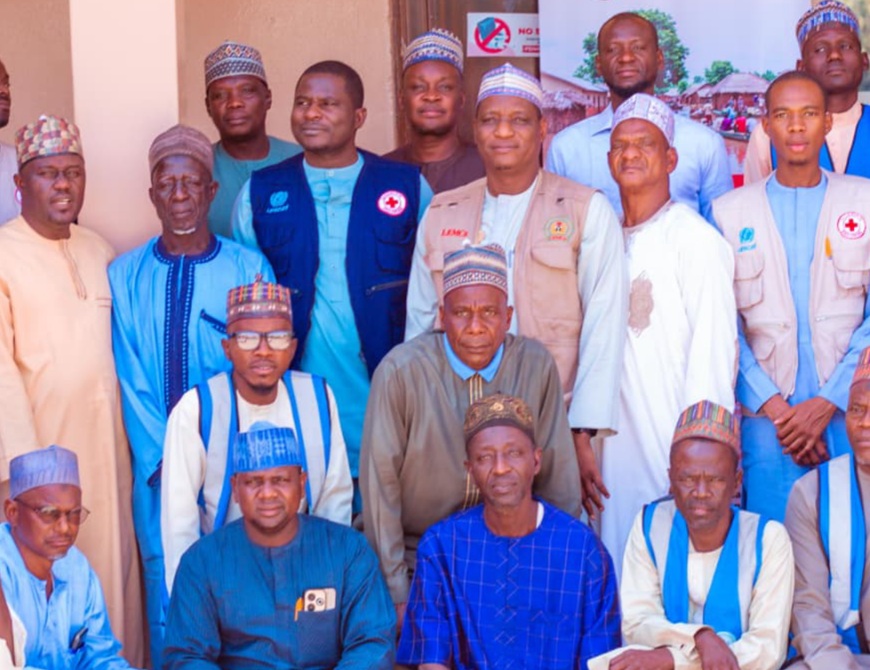
With support from United Nations Children’s Fund (UNICEF) and funding from the European Union, under the Shock Responsive Social Protection (SRSP) anticipatory action project, the NRCS, orgsnized a multi-stakeholder validation workshop in Dutse, as a wake up call.
The series of stakehokder engagements mobilised the Media, the Jigawa state Emergency Management Agency (JISEMA), Civil society organisations, local government policy makers and some Consultants, to strategically work on the Community Emergency Response Plan (CERP) and Standard Operating Procedures (SOPs).
Mr Timothy Yohanna, the disaster management coordinator of the NRCS made several presentations duribg the workshop, where he explained reasons for the mobilization as well as highlighted the roles of all the stakeholders in risk and disaster management.
He stressed that having worked closely with three flood prone Jigawa communities of Auyo, Hadejia and Miga local government areas, NRCS has developed a Local Emergency Management Committees (LEMCs).
A major milestone achievement according to Mr Yohnnas, is the training of community volunteers for the NRCS, who were trained on rapid response and sensitization on disaster management and response.
During the engagement, the Jigawa Disastee Advocacy Group (JDAG) was launched, with a mandate of advocating for disaster preparedness and rapid response, as well as financing.
The group was strategically formed with solid representation of all stakeholders such as the Media, the JISEMA and Civil Society Organisations, who were expected to work with a document to advocate for funding and commitment of the state and donors to address flood in Jigawa state.
Dr Umar Shitu Madigawa, in a short speech at the workshop, harped on the role of all stakeholders especially the media, saying that all stakeholders possess a corporate responsibility in risk and disaster management.
The Risk and Disaster Management Specialist from the Nigeria Emergency Management Agency (NEMA), further explained that execution of those individual responsibilities would translate into changing the narratives and improving risk and disaster management efforts.
Aisha Ahmed ✍ from Dutse.


