


By Saeed Muhammad Lawan
Yobe State, Nigeria
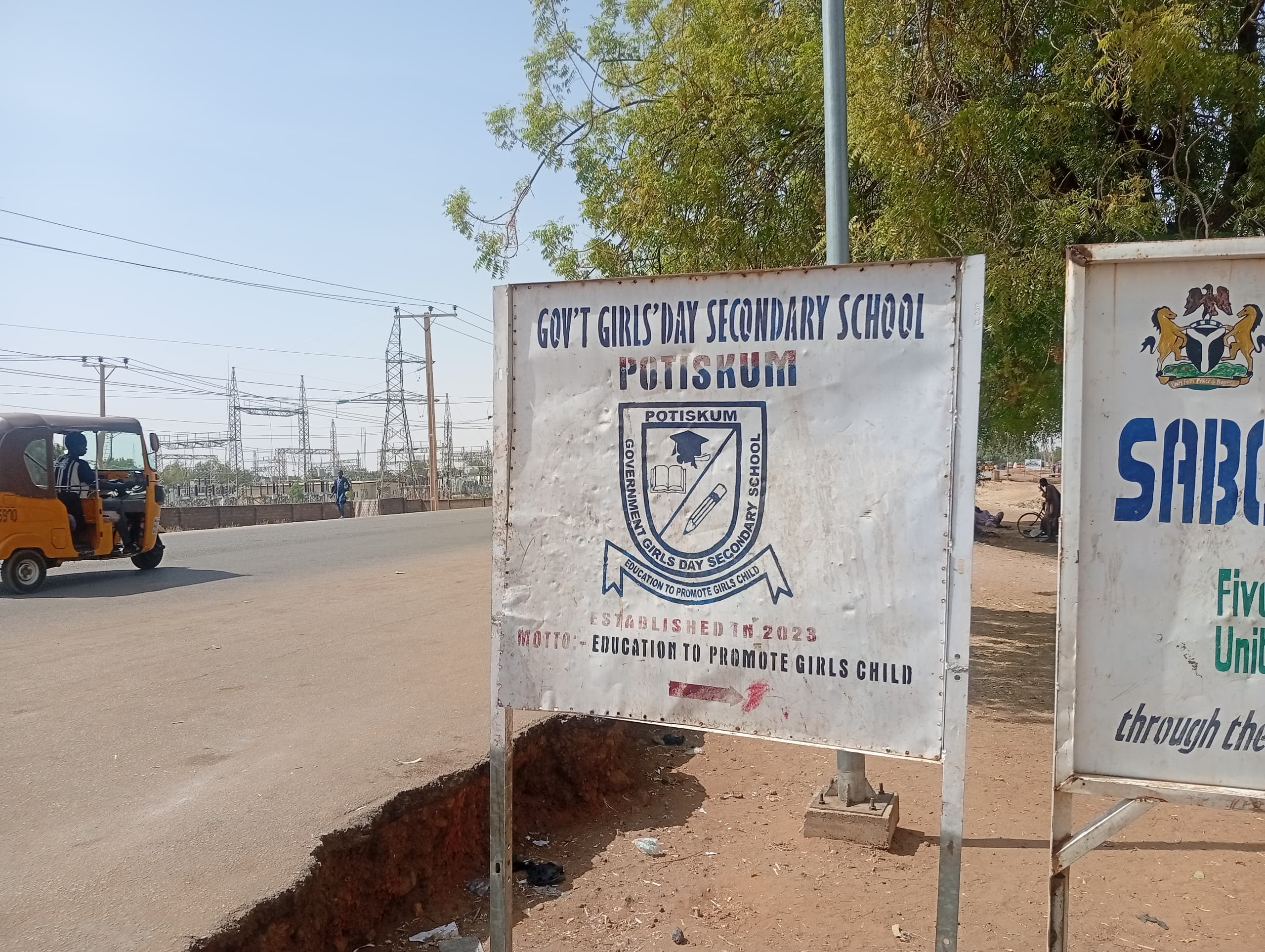
The school day at Government Girls’ Day Secondary School, Potiskum (Women’s Day Academy Potiskum) begins at noon.
It is the worst possible hour. By midday in Potiskum — a commercial hub in the heart of Yobe State, one of the hottest territories in Nigeria — the sun has been burning for six hours. The air shimmers above the asphalt. Sweat dries on skin within seconds. And inside classrooms built for a more forgiving climate, over 150 girls are pressed against one another, shoulder to shoulder, some sharing a single seat, all of them trying to learn.
Salma Inuwa Baaba, 15, takes her seat in SS2A and tries to concentrate. Mathematics is on the schedule. “Honestly, I don’t feel well,” she says quietly, her voice carrying a fatigue that sounds older than her years. “Sometimes I cannot even follow what the teacher is saying.”
She is not alone. Across the hall, her classmate Fatima Isa Muhammad, also 15, describes arriving at school already drained. Fatima walks from a home she says is “very far” — on foot, under the same sun that will soon bake the classroom walls and roof. By the time she sits down, the heat has already begun its work. “I feel tired, like my body has given up,” she says. “Our class is noisy when the weather is cool. But when it is hot, you will find us silent — exhausted and withdrawn.”
These two girls, and the hundreds like them filling classrooms across Yobe State, are on the frontlines of a slow-moving crisis that demands urgent attention. They are the youngest, most visible face of what happens when extreme climate conditions collide with an under-resourced education system — and when that system serves girls.
Ground Zero for a Warming Planet
Yobe State sits at the southern fringe of the Sahara Desert, in the semi-arid corridor known as the Sahel — a region that climate scientists have described as among the most acutely vulnerable to accelerating global warming. The numbers here are not abstract. A peer-reviewed study tracking thirty years of meteorological data from the Nigerian Meteorological Agency found that heat wave intensity across Yobe State has been trending sharply upward, with anomalous highs becoming more frequent and more extreme with each passing decade.
The Nigerian Meteorological Agency (NiMET) has recorded daytime temperatures in states including Yobe, Borno, and Jigawa regularly breaching 40°C between March and May — the very months that overlap with Nigeria’s examination season. In April 2024, parts of the region recorded temperatures approaching 45°C. The World Meteorological Organisation has confirmed that 2023, 2024, and 2025 are the three hottest years in 176 years of global observational records. Nigeria’s average temperature has risen by approximately 1.2°C in recent decades and is projected to climb further.
The heat is not a future threat. It is inside the classrooms of Potiskum, right now, every school day.
150 Girls, Insufficient Air, No Relief
Malam Ali Bitinga has taught biology at Women’s Day Academy Potiskum long enough to understand that heat is not merely an inconvenience — it is a competing force inside his classroom.

“The heat affects almost every aspect of teaching and learning,” he explains, with the measured tone of a man who has observed the problem across many seasons. “Because of the overcrowding, and because every girl needs room to breathe, the struggle for space and air causes disorder. There is noise and interruption even while the lesson is ongoing.”
He is the Head of the Biology Department and the school’s External Examination Officer. He knows what examinations demand: sustained focus, the ability to recall and apply knowledge, freedom from distraction. What his classroom offers during a heatwave is the opposite.
“When the heat has passed,” he says, “you can find three or four students sitting close together, sharing a seat, studying without a care. But when the weather is hot, they are restless — always shifting, looking for more space, more air. It never stops disturbing the class.”
His response to this reality is improvised and telling. He has reorganised his own teaching around the crisis. “I take them outside whenever I can,” he says. “I teach biology, so there are topics that belong outdoors anyway. When I find one, I move the class into the open. I cannot reduce the number of students, so I change the environment.”
He has also thought carefully about what better buildings would look like — ceilings designed to prevent heat from collecting above the students, ventilation planned for a climate that grows hotter every year. “The way these classrooms are built is part of the problem,” he says. “The engineers need to think about what our weather is actually doing now, not what it was like twenty years ago.”
It is a reasonable observation. It is also, within the institutional reality of Yobe State’s public education system, a request that has yet to receive a meaningful response.
What the Science Says About Heat and the Mind
The experience Salma and Fatima describe — the inability to follow lessons, the creeping fatigue, the mental fog — has been documented in research across multiple countries.
A study drawing on data from millions of students who sat standardised examinations found that rising temperatures during the school year produced measurable declines in learning outcomes, with the impact compounding over time. Students from lower-income households, with fewer resources to offset the heat — no fans at home, long walks to school, more hours spent in hot environments — suffered disproportionately. Disrupted sleep from overnight heat further impaired thinking during the following school day.
Peer-reviewed research has found that thermal discomfort can reduce cognitive performance by as much as 24 percent. The mechanism is physiological: extreme heat elevates heart rate, overtaxes the body, and degrades the working memory and concentration required to follow a complex lesson or sit an examination. Research consistently identifies a narrow temperature range — approximately 20°C to 22°C — as optimal for learning. A classroom in Potiskum on an April afternoon may be running at double or more that threshold.
Mathematics — the subject Salma says causes her the most difficulty in the heat — has been identified in multiple studies as among the disciplines most sensitive to thermal disruption. A demonstrable negative relationship exists between classroom temperature and mathematics performance, even within a range of a few degrees.
“I cannot understand it,” Salma says of mathematics class during a heatwave. The science does not say she lacks ability. It says she is hot.
Girls Pay the Highest Price
In Yobe State — and across the North East and North West regions — the collision of extreme heat with structural inequality falls hardest on girls.
A 2025 study by Plan International conducted across ten Sahelian countries found that intensifying climate shocks are directly accelerating school dropout and increasing vulnerability to child marriage and gender-based violence among adolescent girls. The study draws on responses from nearly one thousand girls and young women aged 15 to 24. Their experiences, though gathered across the region, echo those of the girls sitting in overcrowded classrooms at Women’s Day Academy Potiskum.
Climate-related disruptions already affect the schooling of approximately 37.5 million students globally each year, according to World Bank data, with girls consistently the first to be withdrawn when household conditions become strained. In northern Nigeria, where the girl-child remains among the most educationally marginalised, heatwaves are not merely a comfort problem. They are an attrition mechanism.
Over 60 percent of Yobe State’s land area has been documented as affected by desertification — the same creeping process that is warming the air above the state’s schools. The communities these girls come from are already under ecological stress. When the school environment fails them on top of that, the calculation facing families about whether a daughter’s continued schooling is worth the effort shifts dangerously.
Fatima’s daily journey captures this compounding precarity. She walks a long distance under the fiercest sun of the day to reach a classroom that, by the time she arrives, is already oppressively hot. She knows what is at stake. “I strive to work harder,” she says, despite everything, “because I know the importance of education.”
An Architecture of Neglect
There is a structure to this crisis — visible in classrooms designed without the current climate in mind, audible in the disorder that erupts when temperatures rise and girls scramble for air, measurable in class sizes that exceed 150 students when any reasonable educational standard recommends a fraction of that number.
Malam Bitinga describes the architectural failure without bitterness, but without softening it either. The buildings, he suggests, were not conceived for the heat that climate change is now delivering. Roofing designed to dissipate rather than retain heat, ventilation suited to the Sahel’s evolving conditions, ceiling heights and materials that respond to a warming climate: these are technical questions, but they are also political ones. They require commitment. They require someone in government to decide that the girls of Women’s Day Academy Potiskum warrant the investment.
That decision has not yet been made.
In the meantime, a biology teacher improvises in the only way available to him. Girls with long journeys arrive at noon already depleted and attempt to absorb mathematics in stifling heat. A 15-year-old who wants to learn stares at a whiteboard and cannot hold what she sees.
What Needs to Change
The remedies are not complicated or unknown. Where electricity supply can be made reliable, cooling changes educational outcomes dramatically. Where it cannot — as is frequently the case across northern Nigeria — passive design interventions carry significant weight: roofing materials that reflect rather than absorb heat, higher ceilings that allow hot air to rise away from students, deliberate cross-ventilation, shaded outdoor teaching areas.
Adjusting the school timetable so that classes begin earlier in the morning, before the day reaches peak heat, is among the most cost-effective interventions available. It requires no construction budget. It requires a decision. For Fatima, who arrives at noon already worn from her walk in the sun, an earlier start could change the entire complexion of her school day.
At the state and federal level, extreme heat must begin to be treated as an educational emergency — not a seasonal inconvenience. School infrastructure programmes must factor the Sahel’s accelerating heat into their design specifications. Teacher support must acknowledge the additional burden that managing a classroom in extreme heat places on educators like Malam Bitinga, who are already stretched.
The girls who fill the classrooms of Women’s Day Academy Potiskum are not passive recipients of a broken system. They are — as Fatima makes clear — fighting for their futures despite it. The question is whether the institutions that are supposed to serve them will begin fighting alongside them.
Staying Anyway
Outside the school gates in Potiskum, the afternoon heat is white and relentless. The girls of Women’s Day Academy file back to class after a short break, returning to spaces that the science and their own testimony agree are working against them.
Salma will sit through mathematics. Fatima will endure the heat she trekked through to reach. Malam Bitinga will look for a biology topic he can take outside.
And next year, the temperature will likely be higher.
The question this story poses is not whether these girls are resilient enough. They have already answered that. The question is whether Yobe State — and Nigeria — is paying close enough attention to act before another generation of girls is failed by a crisis they did not create and cannot, alone, survive.
Reporting conducte d at Women’s Day Academy, Potiskum, Yobe State, Nigeria. Interviews with Malam Ali Bitinga (HOD Biology, External Examination Officer), Salma Inuwa Baaba (SS2A, age 15), and Fatima Isa Muhammad (SS2B, age 15). Interviews were conducted in Hausa and translated.
