


Abuja, March 5, 2026
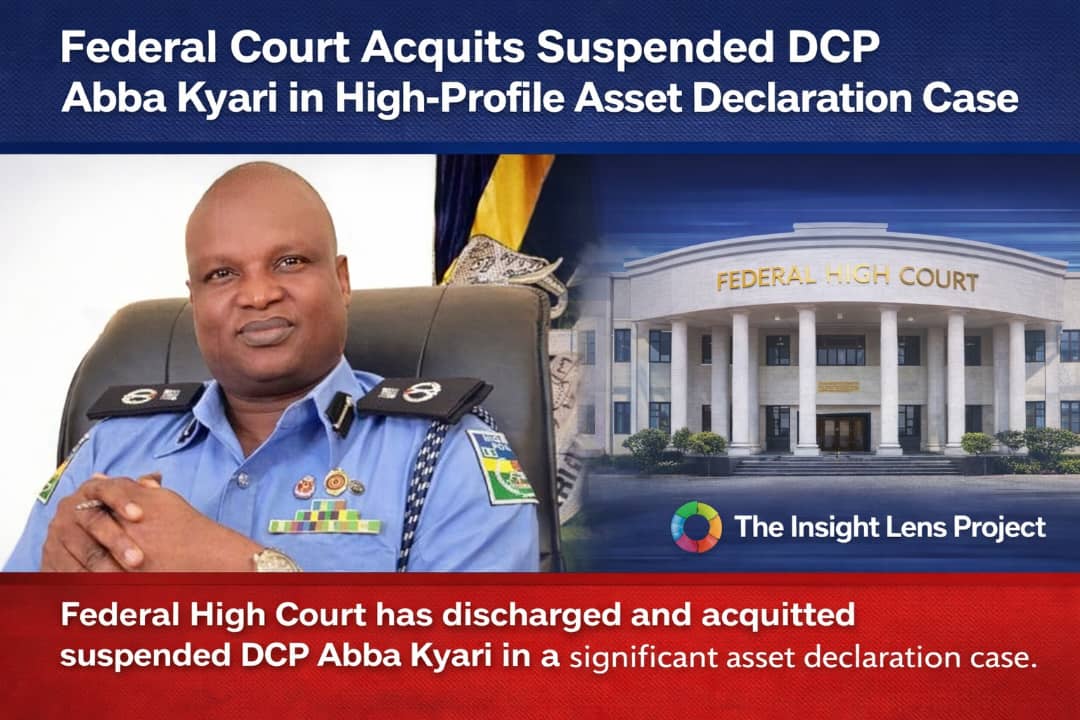
In a landmark ruling that has captured national attention, a Federal High Court in Abuja on Thursday discharged and acquitted suspended Deputy Commissioner of Police (DCP) Abba Kyari of 23 counts relating to non-declaration of assets, conspiracy, and false affidavits.
Justice James Omotosho, delivering the judgment, emphasized that the prosecution had failed to meet the required legal threshold, underscoring the judiciary’s insistence that evidence, not public attention, must guide the course of justice.
Kyari, a former head of the Police Intelligence Response Team (IRT), rose to prominence for leading high-stakes investigations into kidnappings, cybercrime, and terrorism.
His career, however, has been shadowed by controversy since 2021, when the U.S. Federal Bureau of Investigation (FBI) alleged his involvement in a cyber fraud scheme linked to Nigerian influencer Ramon Abbas, popularly known as Hushpuppi.
The FBI claimed Kyari received bribes to detain a rival fraudster, a charge he has consistently denied, asserting that his engagement was strictly professional.
Following the indictment, the Nigerian Police Service Commission suspended Kyari in August 2021. An extradition request approved by the federal government in 2022 was later struck down by the Federal High Court, which cited procedural flaws and insufficient evidence.
Separately, Kyari faces ongoing investigations by the National Drug Law Enforcement Agency (NDLEA) over alleged involvement in a cocaine trafficking network, though these charges are unrelated to the asset declaration case.
The case resolved on Thursday centered on allegations that Kyari and his two brothers failed to declare certain properties and submitted false affidavits to conceal ownership.
The properties in question were located in Asokoro, Abuja, Maiduguri in Borno State, and other locations across the country.
In his ruling, Justice Omotosho found the prosecution’s evidence “insufficient, unsubstantial, and, in some respects, potentially in bad faith,” noting a lack of clear documentation or witness testimony linking Kyari to the properties.
Kyari, who had been granted bail in July 2023, welcomed the decision, which formally clears him of all charges in the matter.
Legal analysts say the acquittal is significant not only for Kyari, but for broader law enforcement and governance frameworks in Nigeria.
It reinforces the principle that every citizen, regardless of rank or public profile, is entitled to fair trial standards.
The case also demonstrates the importance of separating distinct legal proceedings, ensuring that unrelated allegations do not cloud judicial clarity or public perception.
The ruling comes amid a climate where high-profile officers face intense scrutiny both at home and abroad.
Kyari’s prior implication in a U.S.-based fraud investigation highlights the transnational nature of financial crimes, requiring Nigerian authorities to adhere strictly to procedural and evidentiary standards in both domestic and international contexts.
Policymakers and law enforcement agencies are urged to draw lessons from the case, investigations must be thorough, meticulously documented, and insulated from procedural errors.
Maintaining transparent communication with the public can strengthen institutional credibility, while preserving the separation of distinct charges protects both judicial integrity and the rights of individuals.
The Federal High Court’s decision in the Kyari asset declaration case, stands as a sober reminder that justice rests on evidence and due process.
While this chapter concludes with acquittal, ongoing trials on separate charges continue to test the interplay of law enforcement accountability, institutional oversight, and governance in Nigeria.
For citizens and institutions alike, the case underscores the enduring need for transparency, rigor, and the rule of law.
©️ Adebamiwa Olugbenga Michael is a Lagos-based political economy and policy intelligence analyst and publisher of The Insight Lens Project, providing data-driven insights across Nigeria and West Africa using open-source data.
