





Nov. 17, 2025
Soil Values, in collaboration with the Centre for Dryland Agriculture (CDA), Bayero University Kano, has organized a Field Day on Integrated Soil Fertility Management in Kano and Jigawa states to help smallholder farmers restore soil fertility and improve cowpea production.
In Takai local government area in Kano State where declining soil fertility has gradually eroded farmers’ confidence, new hope is beginning to emerge.
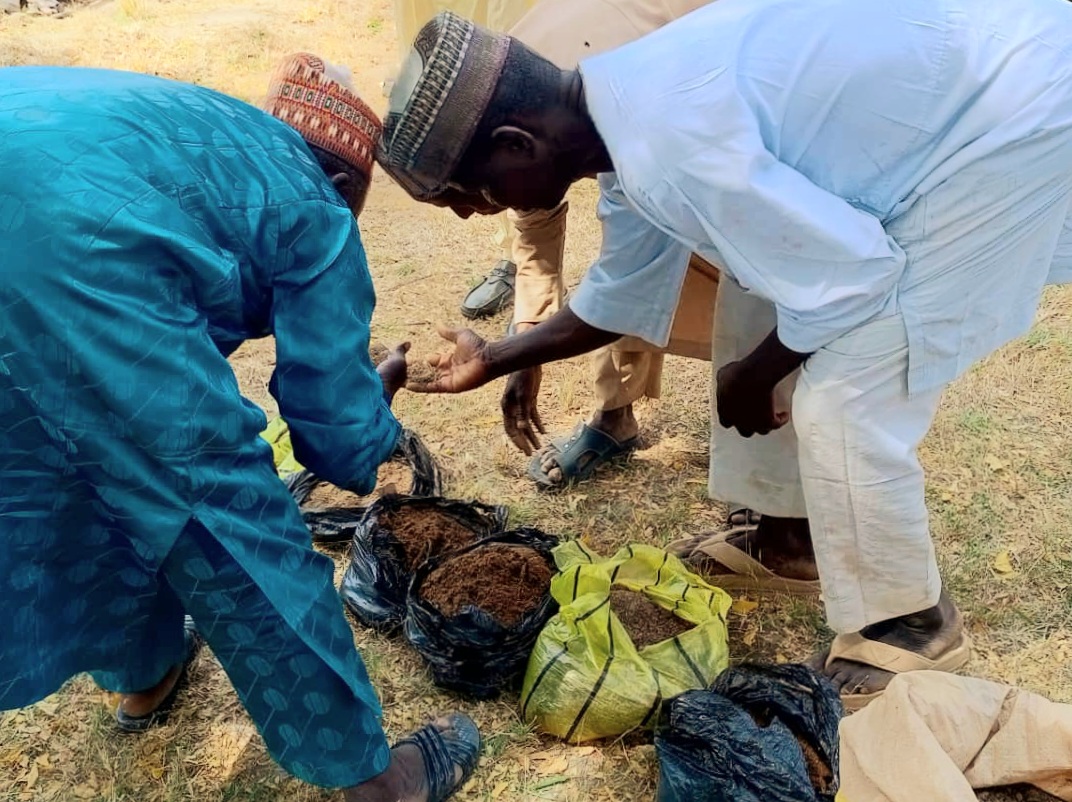
The trial was conducted on the farm of Ahmad Isa Falali, where four demonstration plots were set up with each using inorganic fertilizers, the farmer’s traditional practices, the use of organic fertilizers, and the ISFM (Integrated Soil Fertility Management) approach simultaneously.
This comparative trial not only provided technical training, but also allowed farmers to see first hand process of soil restoration.
“The training has changed the way I produce cowpea. I learnt how to make compost, recycle residues and adjust nutrient levels and it turned the ISFM plot into an ‘open-air classroom’ for me,” said Ahmad one of the farmers.
Representing the CDA Director of Research, Dr. Bassam Abdulrahman described the Field Day as one of the activities of the Soil Values project, funded by the Government of the Netherlands for a period of ten years.
The project he said, aims at improving land use in Kano, Jigawa and Bauchi states through beneficiary training.
One of the most striking interventions came from a woman farmer, Rayya Ibrahim, who explained that the training had given her “the confidence needed to properly manage the soil.”
She pledged to step down her newly acquired knowledge onto the women in her group, thus illustrating the importance of women’s involvement in soil management.
In Falali, the message was clear: soil health is not a mystery, but a skill that farmers can reclaim.
It was gathered that the training is part of a ten-year initiative funded by the Kingdom of the Netherlands through its Directorate-General for International Cooperation (DGIS).
The program is implemented by three partners, the International Fertilizer Development Center (IFDC), SNV Netherlands Development Organisation, and Wageningen University & Research (WUR).
The program also includes five scientific partners: the International Institute of Tropical Agriculture (IITA), AGRA, ICRAF, ISRIC, and the International Water Management Institute (IWMI).
“The essence of the program is to reduce the yield gap, improve soil fertility, and encourage farmers to give back to the soil in order to ensure long-term productivity and food security,” he concluded.
The Soil Values program operates in a context marked by climatic and socioeconomic challenges faced by Sahelian countries, such as recurrent droughts, sociopolitical conflicts, desertification, and the effects of climate change.
The initiative is built around three areas of intervention (Agroecology, Inclusive Markets, and Enabling Environment), as well as five domains of action (Clustering, Integration, Linking, Dialogue, and Analysis & Learning).
The Soil Values program aims to improve the fertility and productivity of two million hectares of agricultural land in the Sahel—specifically in Burkina Faso, Mali, Niger, and northern Nigeria—while strengthening the resilience and well-being of 1.5 million farmers, with a particular focus on women and youth.
With a budget of 100 million euros, the program aims to restore degraded lands across the Sahel—including Nigeria, Burkina Faso, Mali, and Niger—and to reach 1.5 million smallholder farmers.
The goal is to restore two million hectares of degraded land in the Sahel. In Nigeria, 800,000 hectares are expected to be restored, directly benefiting 600,000 small producers.
Aisha Ahmed ✍ from Dutse

